Flying in the Last Frontier
PUBLISHED 2026-08-27 | BY Jesse Pisel
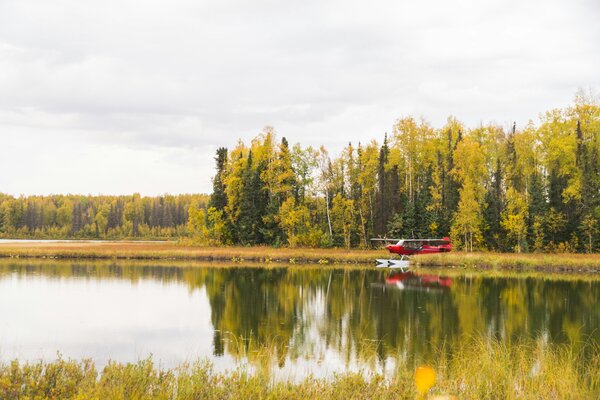
Photo by Daniel Weiss on Unsplash
The Two Alaskas You Fly To
I watched them both from the same window at Fairbanks International.
To my left, a Boeing 737 rolled toward the runway, its belly full of passengers bound for Seattle. One hundred eighty-nine souls, give or take, heading 1,500 miles south for the cost of a nice dinner out. The promo email read $289. To my right, a Cessna 208 Caravan trundled past on its way to the FBO, its single turbine humming a higher pitch than the jet’s fan. It carries nine people to places like Arctic Village, 240 miles north-northeast for what I assume is in the $400-500 price range. But the real contrast comes when you leave the airport entirely. From the numerous small private floatplane lakes around Fairbanks, Chena River Seaplane Base, the East Ramp at FAI, and a dozen others absent from most maps, that same Caravan with floats can take you to a remote lake 100 miles away with no airstrip, just water for over $3,800.
In Alaska, destination matters more than distance.
Alaska’s aviation market exemplifies alignment. Systems optimize for different objectives based on who they serve. In AI we call this the alignment problem, the challenge of ensuring systems pursue actual goals, not just specified metrics. Alaska’s solution is segmentation. The market splits and each segment finds its equilibrium.
Note: I wrote this post before the heartwrenching crash in western Alaska last week. My heart goes out to the families and colleagues impacted. Support one family here.
The Jet Set
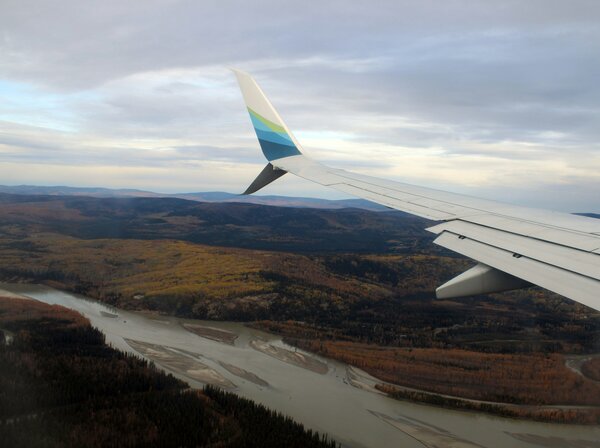
Photo by Brianna Marble on Unsplash
I have made that Seattle flight countless times. You board through a jet bridge, settle into your seat, fire up your laptop or strike up a conversation with your new best friend in the seat next to you, just like everyone else. The 737-800 on this route carries 162-189 passengers, depending on configuration. At cruise, it burns roughly 5,000 pounds of fuel per hour, about 4 gallons per seat which works out to 126 passenger-miles per gallon. That beats your Outback with three friends inside (note: for all calculations the pilot/flight crew/driver is not included for PMPG)
- Miles per gallon (MPG) = miles per hour / gallons per hour
- Passenger-miles per gallon (PMPG) = MPG * # passengers
| Vehicle | Average miles per hour | Average gallons per hour | MPG | # of Passengers | PMPG |
|---|---|---|---|---|---|
| 737-800 | 500 | 750 | 0.667 | 189 | 126 |
| Subaru Outback | N/A | N/A | 31 | 3 | 93 |
The savings go beyond fuel. Airlines amortize every ticket agent, gate staff, and flight attendant salary across dozens of daily flights. A plane costs tens of millions but flies for decades. Competition keeps prices honest. Alaska Airlines, Delta, and others chase your $290. As of summer 2026, one-way Saver fares from Fairbanks to Seattle start at $289, with deals dipping as low as $125-188. The beauty of economies of scale where fixed costs spread so thin they vanish into the balance sheet.
Volume drives the FAI-SEA route. Thousands of travelers move between Alaska’s interior hub and the Outside every month. The market stays liquid, the infrastructure solid. The alternative, a 2,200-mile drive through Canada, takes 40 hours if the border is open and the weather cooperates. Not to mention the cost in fuel for your Outback at $390 (2,200 mi / 31 MPG = 70.96 gal x $5.50/gal = $390). Add hidden maintenance costs for your vehicle after making the adventure. No one in their right mind chooses that over a three-hour flight.
The Bush League

Photo by Daron Kuzina on Unsplash
Now drive across town to Chena River Seaplane Base, or down to the East Ramp, or to any of a dozen other floatplane lakes dotting the area. The pavement ends before the dock. The air smells like oil, avgas, and coffee. A float-equipped Beaver idles at the dock, its Pratt & Whitney radial coughing blue smoke into the morning air. Nearby, a Caravan on floats sits with its cargo door open, while a Super Cub on amphibious floats waits for skis to be reattached when winter comes back. These are the real gateways to the other Alaska.
The other Alaska has villages. Kotzebue, Utqiaġvik, Fort Yukon, McGrath are places you cannot drive to. Alaska Airlines and Bering Air sell seats to Kotzebue for $182-244, the same price as many flights in the Lower 48. The advantage of the 737 PMPG also applies to these villages with runways large enough to accommodate them. Wright Air Service flies scheduled service to Utqiaġvik for $828 one-way, the North Slope’s oil industry keeping prices reasonable. Warbelow’s Air Ventures runs Bush Mail Flights to Circle or Central for $249 as shared rides on daily mail runs, the budget way to reach the villages (although those two are still on the road system).
Villages are just one part of the spectrum. The de Havilland DHC-2 Beaver is a legend out here. Built in the 1950s, the DHC-2 Beaver carries one pilot and up to six passengers, or a lot of cargo, or a mix of both. The Cessna 208 Caravan is newer, seating 9-14 and burning 50-65 gallons per hour. The Piper PA-18 Super Cub, with just two seats, burns 8-9 gallons per hour.
These planes do not benefit from economies of scale. Operators like Rust’s Flying Service charge $1,931 per hour for their Cessna 208 Caravan. $19 per minute. For a remote lake 100 miles out, a 40-minute flight, you are looking at a 2-hour minimum charge of $3,862. Operators cannot make money on 40-minute hops. the direct operating cost alone runs $779-1,021 per hour for a Caravan before profit.
The spectrum runs from $182 for a seat to Kotzebue to $249 for a mail flight to Circle to $3,862 for a charter to a lake with no airstrip. No alternatives exist. Driving is impossible. No trains or ferries run there. Pay the fare, get creative, or stay home.
Here are the passenger-miles per gallon ballparks for these aircraft compared to a new Ram 1500:
| Vehicle | Average miles per hour | Average gallons per hour | MPG | # of Passengers | PMPG |
|---|---|---|---|---|---|
| DHC-2 | 150 | 25 | 6 | 7 | 42 |
| 208 Caravan | 185 | 52 | 3.6 | 9 | 32 |
| Super Cub | 100 | 7 | 14 | 1 | 14 |
| Ram 1500 | N/A | N/A | 12 | 3 | 36 |
The Infrastructure Divide
Fairbanks International has smooth pavement, bright lights, and a fuel farm that tops off a 737 in minutes. FBOs pump Jet-A at $9.16 per gallon in the summer 2026. 100LL avgas in the FAA Alaska region average hit $10.90 per gallon this year. Airlines negotiate airport fees, ground handling, and terminal costs in bulk.
At the other end of a bush flight, runways vanish replaced by water, gravel bars beside rivers, or patches of tundra marked only by backpacks of those waiting for pickup. Aviation becomes necessity here.
That changes everything, starting with fuel. In Fairbanks, that $10.90 per gallon is only the start. At Chena River Seaplane Base or the East Ramp, prices climb. Trucks bring the fuel, then drums, then pumps move it into the plane’s tanks. Every gallon feels like it costs more than the last.
Hidden costs emerge. The Interior has sparse navigation aids and limited weather reporting. Gravel runways go unplowed. Towers close at night if they exist. Planes outlast their pilots. Beavers built in the 1950s still fly. Super Cubs from the 1940s remain airworthy if treated with respect. Insurance costs more for bush operators than regional airlines because the risk profile differs. Forced landings in the Brooks Range differ from diverting to an alternate airport 50 miles away.
Maintenance adds another layer. Operators fly in parts and mechanics. If something breaks on the lake, you either fix it with what you have or wait while paying for a plane to sit idle until another brings what you need.
Demand is thin. Thousands fly FAI-SEA every day, but only dozens head from Fairbanks out to the bush each week. Some days bring one passenger, others bring ten. But the plane still flies if the mail and cargo are going, and the mail always goes.
The Value
The spectrum has a purpose. At one end, regional airlines connect villages to the world. Kotzebue, McGrath are places where people live, work, and raise families. For $182-244, you get a seat on Alaska Airlines or Bering Air. For $249, you get a spot on Warbelow’s mail run. These flights are lifelines. They bring groceries, medicine, mail, a connection to the world beyond the internet.
At the other end comes freedom. A Cessna 152 on floats is simple. It has two seats, burns 6.1-7.0 gallons per hour at cruise, and has 300-400 nautical miles of range with the right tanks. On floats, the 150 burns a bit more, around 8.4 gallons per hour, and the range stretches to 455 nautical miles on a Cessna 150 on floats. That range reaches places absent from any map, places with no roads, no electricity, no other people for miles, just you, the plane, and whatever watches from the brush.
The first time I landed in a Cessna 152 on floats remains unforgettable. The plane touched down on a glassy lake beyond the Tanana River, the floats displacing water that had not seen a propeller in months. The engine spooled down, the only sounds the lapping of waves against the hull and a distant loon. No runway, no terminal, no other people, just water and trees and the kind of silence you only find 100 miles from anywhere.
The two ends serve different purposes, but they share the same truth. Bush flying reaches places otherwise unreachable. Speed does not matter. In the Lower 48, a Cessna 152 is a trainer. In Alaska, on floats, it is the difference between standing on a dock and standing on an empty ridge. The value lies in accessibility. Without the plane or creative alternatives, no travel exists. Only staying.
In Alaska, owning a plane transcends hobby status. It becomes truck, boat, and passport to places most people never see. A 152 on floats transcends transportation. It represents freedom.
The Market Reality
This is price discrimination. In Alaska, it is segmentation. The market splits into three tiers.
At the top, commercial airlines compete on major routes. Alaska Airlines, Delta, and others keep prices in check through competition and volume.
In the middle, regional carriers and mail flights connect villages. The Essential Air Service program subsidizes 65 Alaska communities supporting more communities than any other state though that support faces budgetary pressure. Not every remote strip qualifies for EAS. The market fills the gap. Wright Air Service to Utqiaġvik, Warbelow’s to Circle, Bering Air to Kotzebue.
At the bottom sits the pure charter market. No subsidies exist, no competition, no alternatives. Operators face monopoly conditions, limited demand, and high fixed costs with no economies of scale. Planes must fly, pilots paid, fuel purchased, insurance current. If only a handful of people need to reach the bush this week and the plane holds nine, the cost per seat follows the math. Need to get out today? You pay the operator’s quote.
Simple arithmetic explains the costs. A 737 seat to Seattle costs $289, a regional airline seat to Kotzebue $182-244, and a charter to a remote lake 100 miles away $3,862.
The segmentation mirrors a classic AI challenge. Specification gaming offers an example. Tell a model to minimize cost-per-mile, and it will fly the 737 empty. Tell it to maximize passenger count, and it will pack the Caravan until it cannot take off. The market’s solution is tiered pricing based on value instead of distance, elegant in its simplicity. It avoids the perverse incentives that plague poorly specified AI objectives, where systems optimize the metric at the expense of the actual goal.
Two Alaskas
Back at Fairbanks International, both planes depart. The 737 climbs south toward the Alaska Range, its contrails dissolving in the jet stream. The Caravan turns northwest, following the Tanana River toward the Brooks Range, its shadow skipping across the taiga.
Two aircraft, two sets of passengers, two Alaskas. One is the Alaska of itineraries, boarding passes, and frequent flyer miles, the Alaska of Anchorage, Fairbanks, and Juneau, where flying saves time and connects you to the world beyond. The other is the Alaska of necessity, where aviation is infrastructure. The plane is the road. The airport is the driveway. The pilot is the school bus driver, the mail carrier, the ambulance, and the grocery delivery service, all in one.
In the Lower 48, they talk about the digital divide. Alaska faces the infrastructure divide. The price tag reveals your position.
I have flown both ways. I paid $289 for a seat to Seattle and the right price to a remote lake. The price difference did not reflect distance. It revealed what flying and remoteness mean.
One Alaska flies to save time, the other to survive.
These Alaskas reveal a truth about alignment. In the Lower 48, we talk about the digital divide. In AI, we worry about the alignment divide, the gap between what systems are optimized for and what humans actually need. Alaska shows both sides can coexist. The 737 and the Caravan serve different purposes, but neither is misaligned. Each solves the right problem for the right people.
TAGS: location-alaska ai alignment aviation travel