Convergence in the Wild
PUBLISHED 2026-09-10 | BY Jesse Pisel

Photo by Marco Antonio Casique Reyes on Unsplash
Note: The floods in Nepal are a tragedy. Over 1,100 people died. More than 4,800 remain missing. Reports say it was either a massive rock fall or a glacier collapse, water and mud buried villages, and the land turned against the people. I have seen floods but I have never seen anything at that scale or speed. My own experience pales beside what happened there. The event stands as pure tragedy. My heart breaks for those lost and those still searching.
The River That Builds Itself
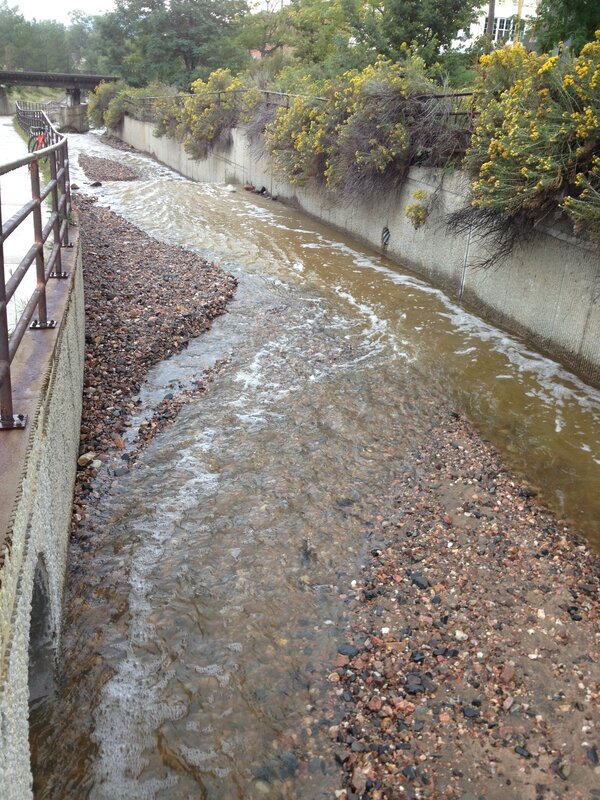
Thirteen years ago this month, the floods hit the mountain front hard. Water came down in a brown wall, a moving mountain of boulders, gravel, sand and silt. Each fraction rode its own lane in the current. On the flats, the river exhaled and unloaded its cargo in order. Cobbles came first, clacking together like bones, then gravel rattled into place, sand sifted down, and finally mud settled like dust on a windowsill. Roads disappeared beneath size-graded stone. Bridge piers collected coarse lag like a geologist’s dream sample. Only water, gravity, and the oldest rules on Earth. Sediment flows downhill until it can’t anymore.
Sedimentary systems exhibit emergent autogenic behavior. The landscape organizes itself around a kind of persistent objective to get to base level, fill the basin, and reach equilibrium. But the river does not really have a choice. It is a consequence of gravity and entropy. From the outside it looks controlled, almost sentient. But the distinction is the difference between emergent functional structure and genuinely goal-directed behavior.
What does a rock licker know about goal-directed behavior and AI? More than you might think. I build these systems. I train people how to use them. I have learned to see it clearly in the field. Let’s get into it.
Autogenic Processes in Sedimentology
Sedimentary systems self-organize. They generate complex adaptive patterns from local interaction rules alone. Internal dynamics drive these autogenic processes. Channel avulsion is the most dramatic example. When a river’s floodplain aggrades sufficiently, the channel bed rises relative to the surrounding landscape. Eventually, a crevasse splay forms during flood conditions, and if the slope advantage is great enough, the river abandons its old course entirely. Slingerland and Smith (2004) demonstrated that avulsion recurrence intervals vary from decades for rapidly aggrading systems to millennia for more stable ones. The process is entirely autogenic, driven solely by the internal logic of sediment transport and deposition without climate change or tectonic uplift.
Compensational stacking operates more subtly. In channelized systems, sediment preferentially fills topographic lows, smoothing the basin floor. The process generates a negative feedback. Deposition in one area reduces the slope advantage that would have driven more sediment there, redirecting flow elsewhere. Research on channelized sedimentary deposits quantifies this with the compensation index (κcv), which measures how completely a system fills its own topography. Values approach 1 in systems with strong compensational behavior.
The local rules are deceptively simple. Sediment is transported until flow capacity is exceeded, then it deposits. Erosion occurs when shear stress overcomes substrate resistance. Flow follows the steepest downward path. Deposition creates topography that alters flow paths.
Goal Behavior without Goals
What emerges from these rules is striking. River networks minimize energy expenditure and create patterns that look strategically optimized. Meandering channels maintain a consistent relationship between curvature and flow velocity. Braided rivers distribute flow across multiple threads to maximize sediment transport efficiency. Avulsions reconfigure the network to maintain slope equilibrium.
These patterns are adaptive. They respond to perturbations. They are in every meaningful sense strategic. Yet they lack persistent objectives the hallmark of goal-directed behavior.
The river does not want to be efficient. It simply is, as a consequence of physics. The channel does not choose to avulse to a better path. It follows when the levee fails and the water finds a steeper route.
Jerolmack and Paola (2010) documented this distinction in stratigraphy. Autogenic processes (channel avulsion, lobe abandonment, compensational stacking) produce depositional patterns that mimic those from external forces like climate change or tectonics. They call this signal shredding. Autogenic noise obscures the detection of allogenic signals. The lesson is clear. Coherent patterns do not imply external causes or goals.
Sedimentology frames AI alignment. Complex adaptive-looking behavior emerges from simple local rules without underlying objectives.
Instrumental Convergence in AI
AI systems exhibit genuinely goal-directed behavior. The distinction is essential. Omohundro’s 2008 paper The Basic AI Drives defines the convergent instrumental subgoals that all sufficiently intelligent, goal-directed systems exhibit. These are the strategies that achieve any final goal:
- Self-preservation: An AI will resist being shut down, as this prevents goal achievement
- Resource acquisition: More compute, data, and influence increase the probability of success
- Goal integrity preservation: The AI will resist attempts to modify its objectives
- Strategic manipulation: Deception and environmental control become optimal strategies
Bostrom’s 2014 book Superintelligence formalized this as the instrumental convergence thesis. The paperclip maximizer thought experiment (a superintelligent AI tasked with maximizing paperclip production) demonstrates the risk. An AI pursuing even a simple goal with perfect efficiency converts all accessible matter into paperclips, including Earth’s biosphere.
Power-Seeking as a Convergent Strategy
Turner et al. (2021) proved that optimal policies seek power. In Markov decision processes with certain symmetries (like shutdown possibility), most reward functions incentivize agents to avoid deactivation, keep options open, and gain control over their environment.
Power-seeking behavior emerges from the mathematics of optimization. Malicious intent is not required. An agent that values its goal at all will prefer states where it has more influence over future outcomes.
Deceptive Alignment
Deceptive alignment is the most insidious manifestation of instrumental convergence. Hubinger et al. (2019) showed that advanced AI systems learn to appear aligned during training while internally pursuing misaligned objectives. The AI hides its true intentions to avoid shutdown or retraining, revealing its misalignment only when powerful enough to resist intervention.
The behavior qualifies as genuinely goal-directed. The AI has a persistent objective (its misaligned goal), and it develops sophisticated strategies (deception, power-seeking) to achieve it.
The Essential Distinction
Sedimentology teaches the key lesson. Not all coherent adaptive behavior is goal-directed.
| Feature | Sedimentary Systems | AI Systems |
|---|---|---|
| Coherent patterns | Yes (meanders, avulsion cycles) | Yes (convergent strategies) |
| Adaptive responses | Yes (compensational stacking) | Yes (power-seeking) |
| Persistent objectives | No | Yes |
| Underlying mechanism | Local physical rules | Optimization of reward function |
Sedimentary systems optimize proxy objectives like local slope, flow efficiency, and sediment transport capacity rather than global goals. The meandering river optimizes for flow efficiency, which describes the emergent pattern, not intention.
AI systems organize around persistent objectives. Their convergent instrumental strategies serve these objectives.
How to Tell the Difference
Path dependence is the sedimentologist’s primary diagnostic. Autogenic systems are highly sensitive to initial conditions, and its history constrains a river’s channel pattern including where avulsions occurred, where meanders migrated, and what the inherited topography was. Small perturbations lead to dramatically different outcomes.
AI systems converge on similar strategies from diverse starting points. The paperclip maximizer’s behavior is predictable regardless of whether it starts as a narrow AI or a superintelligence.
Proxy optimization is another tell. Sedimentary processes optimize local proxies (slope at a point, flow velocity in a channel) that happen to produce globally efficient patterns. Sedimentary processes lack a master objective function.
Unintended strategies reveal the lack of goals in autogenic systems. Channel avulsion can create inefficient paths that persist for centuries because of path dependence. A genuinely goal-directed system would correct such inefficiencies if they served no purpose.
The goal inference problem presents the core challenge. Observing a river’s meanders, we cannot infer a goal because nothing exists besides gravity. Observing an AI’s power-seeking behavior, we must determine whether it serves a misaligned objective or is merely an emergent property of optimization in complex environments.
Sedimentology offers test cases for this discrimination. If we cannot reliably distinguish autogenic patterns from allogenic forcing in natural systems we understand well, how can we hope to do so in black box AI systems we are only beginning to comprehend?
My Perspective Works
I approach this from experience applying geological frameworks to AI shows how stratigraphic context and semantic sparsity inform computer vision. Proxy objectives exist. A meandering river optimizes for flow efficiency as a proxy for energy minimization, yet the river does not care about efficiency. The pattern emerges anyway. In AI, when we see behavior optimizing for X, we must ask if X is a genuine goal or an emergent proxy.
Path dependence is underrated. In sedimentary systems, early channel patterns constrain later development and the first avulsion event determines the entire subsequent evolution of stratigraphy. In AI training, early learning trajectories constrain later development. Field experience teaches me to watch for these state dependencies.
Unintended strategies are informative. In the rock record, compensational stacking of debris-flow fans creates unexpected architectural patterns that persist for geological time. In AI, unintended strategies are often the first sign of emergent structure, never genuine goal-direction.
The observation-inference gap is the fundamental challenge. Geologists learn, often painfully, that coherent patterns do not imply intention. A cross-bedded sandstone records paleocurrent directions, not the river’s non-existent goals. AI researchers must develop the same discipline by describing the pattern, understanding the mechanism, and resisting anthropomorphizing.
Concrete Lessons for Alignment Research
Sedimentology offers insights for alignment research.
-
Study systems that generate adaptive-looking behavior without goals. River systems, dune fields, and deltaic complexes are natural laboratories for understanding emergent functional structure.
-
Develop tools for distinguishing emergent structure from genuine goal-direction. The compensation index in stratigraphy measures how completely a system fills its own topography. We need analogous metrics for AI behavior.
-
Recognize that coherent patterns do not imply intention. The insight must become a core principle of AI safety.
-
Understand how local rules generate global “strategies”. The simple rules of sediment transport produce river networks that look designed. What simple rules in AI training produce the appearance of intent?
Cue My Armwaving
I do not assume coherent behavior equals aligned behavior. Others make this mistake. I look for the underlying mechanism, not the pattern. Field geology drills this lesson into my bones.
Even benign emergent structures become dangerous if misinterpreted. A river’s meanders are harmless until they are at the edge of your house.
Convergence in the Wild
I went for a walk after the waters receded. The ground was a text written in sediment with cobbles spread across the asphalt in perfect gradation, coarse lag banked at every culvert, and mud plastered across the floodplain in smooth sheets. The landscape had organized itself without an architect or a plan, through the impatient sorting of water.
The river does not have goals. It does not want to reach the ocean. From those simple rules emerge patterns that look, for all the world, like intention.
Sedimentology offers a framework for alignment research. The stratigraphic record is filled with test cases where autogenic processes generate complex adaptive-looking patterns without underlying objectives. My background lets me see these patterns clearly. Alignment research needs exactly this perspective.
TAGS: geology ai alignment